 Dallas Mobile Mechanic
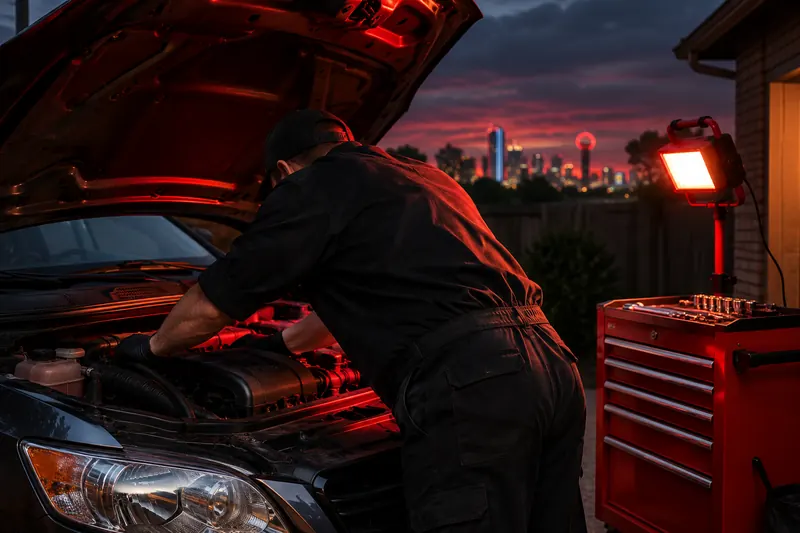
Dallas is a city built around the car. It covers more than 380 square miles, its neighborhoods are tied together by some of the busiest freeways in Texas, and its weather swings from 100-degree summers to hailstorms to the occasional deep freeze. All of that shapes what goes wrong with cars here, and why more Dallas drivers are having the mechanic come to them.
This guide covers how mobile mechanic service works across the city, what Dallas conditions do to your car, and how to get the most out of a mobile visit.
What "mobile mechanic" means
A mobile mechanic brings the repair to your car instead of the other way around. Scan tools, hand and power tools, jacks and stands, and common parts ride in the work vehicle. Most everyday repairs (brakes, batteries, starters, alternators, sensors, belts and diagnostics) can be done in a driveway or a normal parking space.
What you skip: the tow, the ride to the shop, the waiting room and the ride back. In Dallas, where a round trip to a shop can easily mean an hour or more on the road, that's often the bigger cost.
Across the city, neighborhood by neighborhood
We work all over Dallas, and every part of the city has its own patterns.
Downtown, Uptown and Victory Park. Lots of parking garages, high-rise residential buildings and office towers. Most repairs fit fine in a garage space. Building rules sometimes limit work in residential garages, so mention them in your booking notes. Dead batteries in garages are common here, especially for cars that sit during the week.
Oak Lawn, the Design District and the Cedars. A mix of apartments, condos and small business lots close to I-35E and the Woodall Rodgers Freeway. Short trips and stop-and-go driving are hard on batteries and brakes.
North Dallas, Preston Hollow and Preston Center. Mostly single-family homes with driveways, which makes for easy mobile repairs. Lots of commuting on the Dallas North Tollway, LBJ Freeway (I-635) and Central Expressway (US-75), so brakes and tires wear accordingly.
Far North Dallas. Longer commutes and many families with more than one car. A mobile visit can take care of more than one vehicle in a single trip, which is worth mentioning when you book.
Lakewood, Lower Greenville, the M Streets and East Dallas. Older homes, tree-lined streets and lots of street parking. Older cars are common here too, and we see plenty of cooling system and charging problems in summer.
Lake Highlands and White Rock. Neighborhoods off I-635 and Northwest Highway, with plenty of school runs and short trips around the lake. Batteries and brakes are the usual suspects.
Oak Cliff, Bishop Arts and Kessler Park. Southwest of downtown across the Trinity River, with hills, older homes and a lively mix of streets. Easy driveway repairs, and many drivers here commute across the river every day on I-35E or the bridges into downtown.
Pleasant Grove and southeast Dallas. Large neighborhoods along I-30, Loop 12 and US-175. Long distances to many shops make mobile service especially handy here.
The freeways that shape Dallas driving
Dallas drivers spend real time on these roads, and they explain a lot about how cars wear here:
- US-75 (Central Expressway) runs north from downtown through some of the heaviest traffic in the region. Stop-and-go traffic wears brakes fast.
- I-635 (LBJ Freeway) loops across the north side and meets US-75 at the High Five, one of the tallest freeway interchanges in the country.
- I-35E runs north toward Denton as the Stemmons Freeway, and south toward Waco.
- I-30 heads west to Fort Worth and east toward Mesquite and Rockwall. It meets I-35E downtown at the interchange long called the Mixmaster.
- The Dallas North Tollway is the main north-south route for many North Dallas commuters.
- I-45, I-20 and Loop 12 carry traffic across the south and east sides.
Stop-and-go traffic is the hardest kind of driving on brakes, transmissions and cooling systems. Long idles in summer traffic, with the AC running full blast, push batteries, alternators and fans to their limits.
What Dallas weather does to your car
Heat. Summer afternoons in Dallas regularly pass 100°F. In 2011, DFW recorded 71 days at or above 100 degrees. Engine bays get far hotter than the air. Heat is the number one killer of car batteries, speeds up wear on belts and hoses, and stresses cooling and AC systems. Read more in our post on mobile battery replacement in Dallas.
Hail. North Texas is one of the most hail-prone parts of the country, and spring storms can hit hard. A June 2012 hailstorm in North Dallas caused hundreds of millions of dollars in damage. Hail is mostly a body shop problem, but it's also a reason to inspect any used car carefully before you buy. See our pre-purchase inspection page.
Cold snaps. Dallas winters are mostly mild, but sharp cold fronts arrive every year. In February 2021, temperatures at DFW dropped below zero. A battery the summer already weakened often gives up on the first really cold morning, which is why no-start calls spike when the first cold front comes through.
Inspections and emissions in Dallas County
Texas ended yearly safety inspections for most passenger vehicles on January 1, 2025. Instead, drivers pay a small fee when they renew their registration. Dallas County still requires a yearly emissions test, though, because it's in one of the state's air-quality areas. A car with the check engine light on will fail. If your registration is coming up and that light is on, get it diagnosed first.
The repairs Dallas drivers book most
- Batteries. Heat-weakened batteries fail all year, and especially on cold mornings. See battery replacement.
- Brakes. Freeway traffic and city stoplights wear pads and rotors. See brake repair.
- No-starts. Battery, starter, alternator, fuel or ignition. See car won't start.
- Check engine lights. Often tied to emissions test deadlines. See check engine light diagnostics.
- AC. Warm air in July is not something anyone in Dallas waits on. See car AC repair.
- Starters and alternators. See starter and alternator repair.
How to get the most from a mobile visit
- Give the exact location. The street address, plus a gate code, garage level or parking spot number if there is one.
- Describe what the car is doing. Noises, warning lights, when it started and what you've already tried. It helps your mechanic bring the right parts.
- Use the VIN scanner. On your phone, the booking form can read the VIN from a photo of your dashboard or door sticker and fill in the car for you.
- Pick a realistic window. Same-day is often possible if you book in the morning. The form shows only the time windows still open today.
- Mention building rules. Some apartment complexes and HOAs limit repairs in parking areas. Tell us and we'll plan for it.
When a shop is the better call
Mobile repair covers most everyday work, but not everything. Transmission rebuilds, major engine work and jobs that need a vehicle lift belong in a shop. When your repair is one of those, your mechanic will tell you straight away.
Ready when you are
From Uptown garages to Oak Cliff driveways to Far North Dallas cul-de-sacs, we bring the repair to you. Book a visit in about two minutes, or call if you'd rather talk it through.